Please click the link below to download the program.
【JAAS】 60th Annual Meeting Program
Registration is open until May 15 via the link below.
https://forms.gle/jJXruaK7ZMf6EJbf6
2026.04.27 Annual Meeting,What's New,Infomation
Please click the link below to download the program.
【JAAS】 60th Annual Meeting Program
Registration is open until May 15 via the link below.
https://forms.gle/jJXruaK7ZMf6EJbf6
2026.04.26 What's New,Annual Meeting,Infomation
第 60 回年次大会は2026年 6月6日(土)・6月7日(日)に対面にて、東京学芸大学で開催
*プログラムにつきましては、こちらからご確認ください。
(英語版はこちらからご確認ください)。
*参加される方は、5月15日(金)までに、こちら(https
2025.05.26 What's New,Annual Meeting,Infomation
Please click the link below to download the program in English.
2024.09.19 What's New,Annual Meeting,Infomation
The 59th Annual Meeting of the JAAS will be held at Hokkaido University in Sapporo on
May 31 and June 1, 2025. The Program Coordinating Committee invites proposals for the
“Independent Paper Sessions” to be held during the morning of the first day, May 31.
Submission:
Submit your proposal (PDF) that includes: 1) your name and affiliation; 2) the title; 3) the abstract (approximately 800 words); 4) five keywords, via the following section of the American Studies Association website.
https://www.jaas.gr.jp/outline/contact-us.html?lang=en (page in English)
https://www.jaas.gr.jp/outline/contact-us.html#contact (page in Japanese)
Deadline: November 15, 2024.
Acceptance and decline emails will be sent in early January.
Proposal from Japan:
JAAS members are eligible for submission. Non-members wishing to submit proposals are asked to complete the membership application upon submission.
Proposal from outside Japan:
Submissions from both JAAS members and non-members are reviewed. Upon acceptance, non-members are asked to make the conference registration by e-mail no later than March 1, 2025. Also, the 8,000 JPY registration fee (non-refundable) should be paid at the venue prior to the presentation.
* Non-members living outside Japan may present papers once without becoming formal members of the JAAS. From the second time on, you are asked to become a member before presenting a paper. You can apply for the membership upon submission.
** You can present papers for two consecutive years, but not three years in a row.
***All the submissions should be previously unpublished and should not be under consideration for publication elsewhere. The committee accepts proposals in English and Japanese.
****When your proposal is accepted, you will be asked to submit the full paper (approximately 5,000 to 7,500 words in English, 8,000 to 12,000 letters in Japanese) to the Committee no later than May 10, 2025. The paper, locked with the password, will be posted on the JAAS website for the members prior to the Annual Meeting.
The JAAS Annual Meeting Program Coordinating Committee
2024.06.03 What's New,Society Award,清水博賞,Infomation
2023年1月1日から12月31日の期間に出版された著作のな
2024.06.03 中原伸之賞,What's New,Society Award,Infomation
2023年1月1日から12月31日の期間に出版された著作のな
青野利彦(一橋大学)
『冷戦史(上)第二次世界大戦終結からキューバ危機まで』、
『冷戦史(下)ベトナム戦争からソ連崩壊まで』(中公新書)
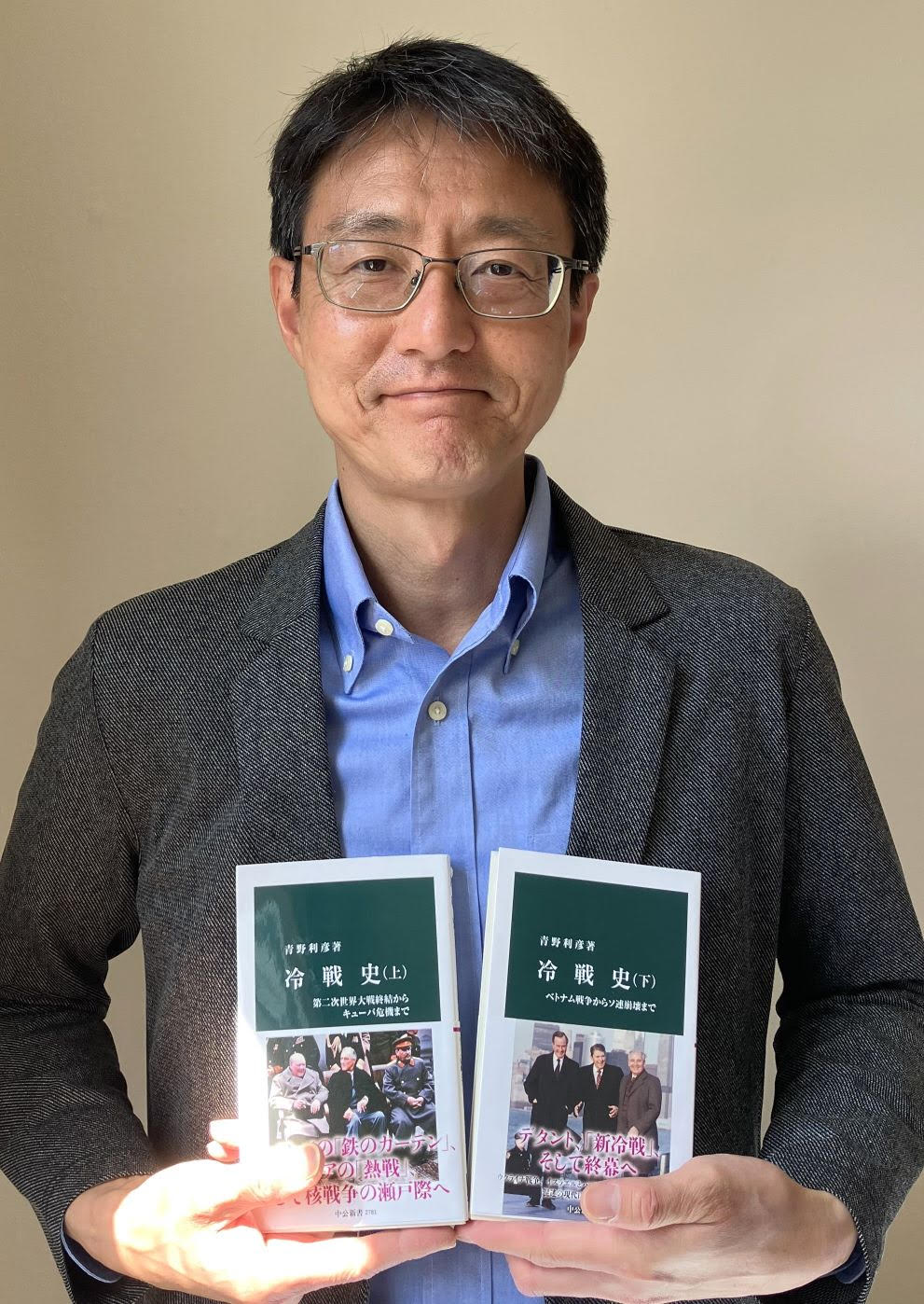
青野会員
2024.04.17 What's New,Annual Meeting,Infomation
The 58th JAAS Annual Meeting will be held on June 1st and 2nd, 2024 at Waseda University, Tokyo.
The Fifty-Eighth JAAS Annual Meeting Program
2023.05.28 What's New,Annual Meeting,Infomation
Map to the Ikuta Campus is below.
2023.05.16 What's New,Annual Meeting,Infomation
2023.05.07 Infomation
The Japanese Journal of American Studies STYLE SHEET AND GUIDE FOR AUTHORS
William H. Chafe, The Unfinished Journey: America Since World War II , 3d ed. (New York: Oxford University Press, 1995), 146-48.
Walter Lippmann and Allan Nevins, eds., A Modern Reader: Essays on Present-day Life and Culture (Boston: Heath, 1936), 76.
John Stuart Mill, Autobiography and Literary Essays , ed. John M. Robson and Jack Stillinger (Toronto: University of Toronto Press, 1980), 15.
Luli Callinicos, Workers on the Rand: Factories, Townships, and Popular Culture, 1886-1942 , A People’s History of South Africa, vol. 2 (Athens, Ohio: Ohio University Press, 1985), 48.
Murasaki Shikibu, The Tale of Genji , trans. Edward G. Seidensticker (New York: Alfred A. Knopf, 1978), 46.
Yoshiko Yoshida, Amerika to Nippon no taiwa [The Dialogue between the United States and Japan] (Tokyo: Shunju-sha, 1995), 189-200.
When romanizing Japanese language titles, capitalize the first word and proper nouns. The accompanying English translation should be capitalized according to note G below. Underlining is not necessary except in cases where the English translation of the Japanese title has been indicated by the author.
Gunnar Myrdal, Population: A Problem for Democracy (Cambridge: Harvard University Press, 1940; repr. Gloucester, Mass.: Peter Smith, 1956), 9.
Mary Wollstonecraft Shelley, Frankenstein: Or, The Modern Prometheus (the 1818 text) , ed. James Reiger (Indianapolis: Bobbs-Merrill, 1974; Chicago: University of Chicago Press, Phoenix Books, 1982), 37.
Leon F. Litwack, North of Slavery: The Negro in the Free States, 1790-1860 (Chicago: University of Chicago Press, 1961; Phoenix Books, 1965), 65.
Jack Goody and Ian Watt, “The Consequences of Literacy,” in Literacy in Traditional Societies , ed. Jack Goody (Cambridge: Harvard University Press, 1968), 34.
Patricia A. Cooper, “What Ever Happened to Adolph Strasser?” Labor History 20 (Summer 1979): 17-30.
Lisa Steinman, “Moore, Emerson, and Kreymborg,” Marianne Moore Newsletter 4, no. 1 (1980): 9.
Konrad Lorenz, “The Wisdom of Darwin,” Midway , no. 22 (1965): 43.
Anne B. Fisher, “Ford Is Back on the Track,” Fortune , 23 December 1985, 18.
“Ethiopia’s No-Win War”, Newsweek , 24 April 1989, 19.
Michael Norman, “The Once-Simple Folk Tale Analyzed by Academe,” New York Times , 5 March 1984.
Encyclopedia Americana , 1963 ed., s.v. “Sitting Bull.”
Columbia Encyclopedia , 1990 ed., s.v. “Tocqueville, Alexis de.”
Sandra Landis Gogel, “A Grammar of Old Hebrew” (Ph.D. diss., University of Chicago, 1985), 46-50.
U.S. Congress, House Committee on Education and Labor, White House Conference on Aging: Report to Accompany S.J. Res. 117 , 90th Cong., 2d sess., 1 May 1968, 5.
Glenway Wescott, Images of Truth: Remembrances and Criticism (New York: Harper, 1962), 128, quoted in William L. Nance, Katherine Anne Porter and the Art of Rejection (Chapel Hill, N.C.: University of North Carolina Press, 1964), 207-9.
Use “ibid.” (not underlined) when referring again to the single work cited in the immediately preceding note. Except at the head of a sentence, “ibid.” should not be capitalized.
See ibid., 52-58.
Use short title forms when referring again to a previous citation not in the immediately preceding note. Include the author, title (abbreviated if necessary), and page number.
Chafe, The Unfinished Journey , 150.
When citing more than one source in a single note, connect the items with semi-colons, and insert “and” before the final item.
Chafe, The Unfinished Journey, 180-81; Cooper, “What Ever Happened,” 24; and Lorenz, “The Wisdom of Darwin,” 46.
Capitalize the first letter of each word, but (with the exception of the first and last words) use lower case for articles, prepositions, the word “to” used as part of an infinitive, and coordinate conjunctions (and, but, or, nor, for).
Economic Effects of War upon Women and Children “What It Is All About”
The capitalization of the original title should be retained in principle, but for the sake of uniformity the capitalization described above may be used.
With regard to Japanese language materials, see A.5. above.
(The) New York Times, (The) Chronicle of Higher Education
When an American location is not well known, include the state name. Abbreviate as follows:
Ala. Alaska Ariz. Ark. Calif. Colo. Conn. Del. D.C. Fla. Ga. Hawaii Idaho Ill. Ind. Iowa Kans. Ky. La. Maine Md. Mass. Mich. Minn. Miss. Mo. Mont. Nev. N.H. N.J. N.Mex. N.Y. N.C. N.Dak. Ohio Okla. Oreg. Pa. R.I. S.C. S.Dak. Tenn. Tex. Utah Vt. Va. Wash. W.Va. Wis. Wyo.
In the case of Cambridge (for example), if the publisher is other than Cambridge University Press, Harvard University Press, or MIT Press, indicate “Cambridge, England” or “Cambridge, Mass.”
The US capital, Washington D.C., should be referred to as “Washington, D.C.” except in the case of publications from bodies such as the US Congress, in which case there is no need to indicate place of publication. See C.4. above.
When a title page indicates more than one place of publication, in principle only the first should be given.
Omit the first “The” and also “Inc.” or “Ltd.”
(The) University of Chicago Press, Alfred A. Knopf (Inc.)