2023年1月1日から12月31日の期間に出版された著作のな
お知らせ
第29回清水博賞のお知らせ
2024.06.03 What's New,Society Award,清水博賞,Infomation
第5回中原伸之賞のお知らせ
2024.06.03 What's New,Society Award,中原伸之賞,Infomation
2023年1月1日から12月31日の期間に出版された著作のな
青野利彦(一橋大学)
『冷戦史(上)第二次世界大戦終結からキューバ危機まで』、
『冷戦史(下)ベトナム戦争からソ連崩壊まで』(中公新書)
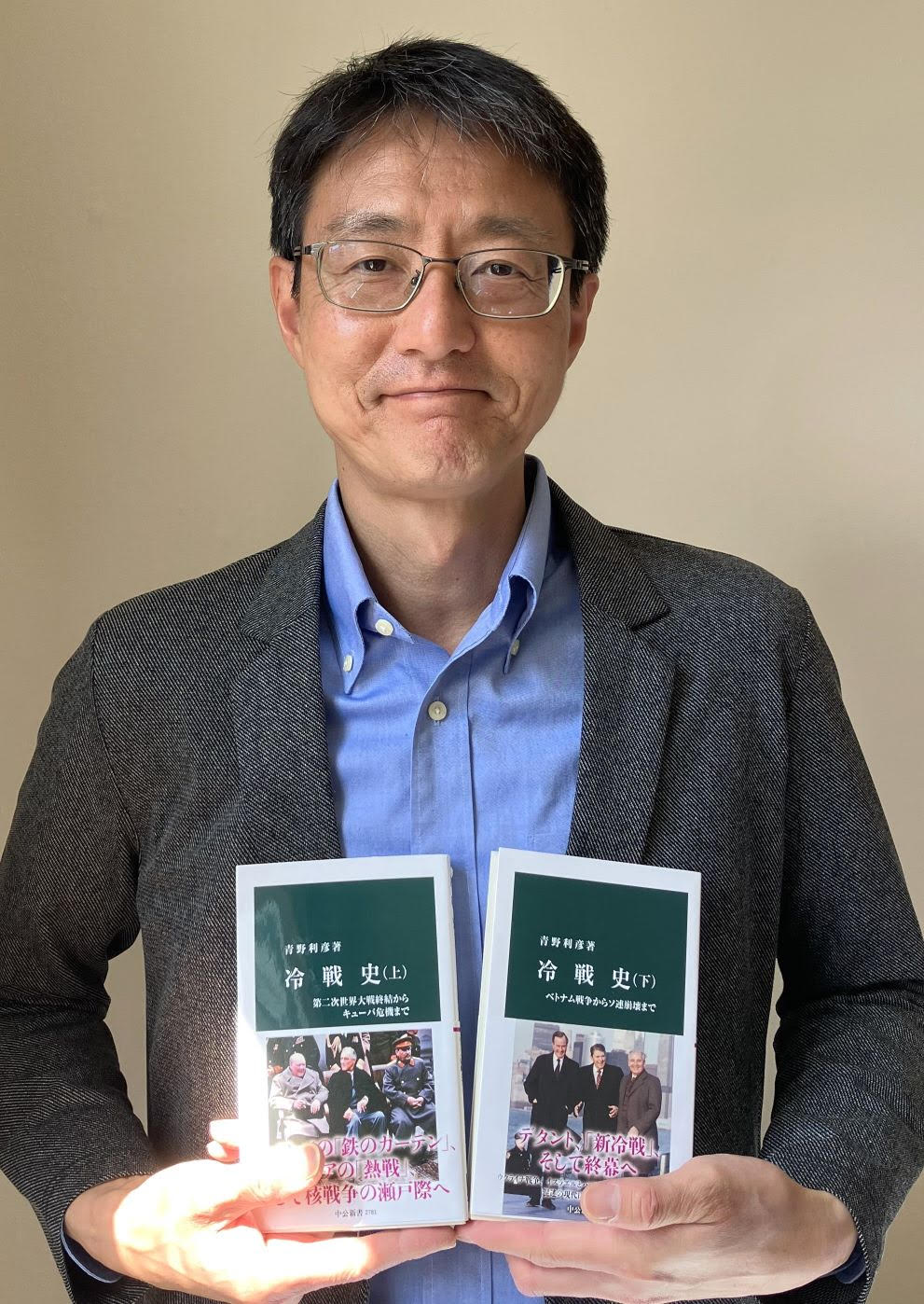
青野会員
The Fifty-Eighth JAAS Annual Meeting Program
2024.04.17 Annual Meeting,What's New,Infomation
The 58th JAAS Annual Meeting will be held on June 1st and 2nd, 2024 at Waseda University, Tokyo.
The Fifty-Eighth JAAS Annual Meeting Program
58. Authoritarianism (2024)
2024.04.14 The American Review
| A Round table Discussion | |
| Affirmative Action and the “Divide” of the U.S. | (1) |
| Special Topic: Authoritarianism | |
| Sojourners and the State: Exploring Jim Wallis’s Prophetic Politics and its Dynamics |
AIKAWA, Yusuke(35) |
| Polyarchy and Political Representation after Democratization in the American South |
HIRAMATSU, Ayako(57) |
| “Exceptions” Defining the “Norm”: “Legal Borderlands” Made Visible by Haitian Refugees |
MURATA, Katsuyuki(79) |
| The Drug-War Capitalism” and the Ethical Decision of Self-Denial: Cormac McCarthy’s No Country for Old Men |
YAMAGUCHI, Kazuhiko(101) |
| Background of the Rising Authoritarianism Rising in the US: Analysis of Employment Structure and Job Polarization, Dynamics of Population and Society in the Trump, Swing, and Democratic States |
YAMAGATA, Hiroyuki(123) |
| Articles | |
| The Prophet in the City of Desire: George Lippard’s Philadelphia Race Riot Novel and the Compromise of 1850 |
HOSONO, Kaori(147) |
| Race and Rice Farming: Japanese Settlers in the American South at the Beginning of the Twentieth Century |
YAMANAKA, Mishio(169) |
| Book Reviews | |
| CHO Fumitaka, The US‒Japan Relations in the Age of “Global Society”: From the “Friendly Competition” to the “Alliance,” 1970‒1980 |
IKEDA, Shintaro(189) |
| TOKUNAGA Yu, Transborder Los Angeles: An Unknown Transpacific History of Japanese-Mexican Relations |
TSUCHIYA, Tomoko(195) |
| MORIYAMA Takahito, Empire of Direct Mail: How Conservative Marketing Persuaded Voters and Transformed the Grassroots |
MIYATA, Tomoyuki(201) |
| NOGUCHI Keiko, Harriet Beecher Stowe and Antislavery Literature: Another American Renaissance |
YAMAGUCHI, Yoshiko(207) |
| The Fifty-Seventh Annual Meeting: A Summery Report | -213 |
| Copyright Policy and Submission Guidelines | -229 |
No.34(2023)Division, Diversity, and Unity
2023.12.13 The Japanese Journal of American Studies
3. Seong-Ho LIM, What Kind of “America” Mattered in the State Building of South Korea? The “Tudor” Polity and the “Progressive” State
29. Yoshiko UZAWA, The Yellow Jacket (1912): Chinese Opera as Techne in Early Twentieth-Century American Theatre
45. Hiro MATSUBARA, “What a Quickening It Was to My Soul”: The Emergence of Women’s Autonomy in the New York Religious Tract Society, 1812–1826
67. Junko ISONO KATO, Counting Diversity in an Attempt to Achieve Unity: How the Three-Fifths Clause United and Divided Americans
89. Yuki ODA, Family Unity and “Noncitizen Citizenship”: The Advocacy of the International Institutes on Behalf of Separated Families
111. Shunta MATSUMOTO, The Role of Congress in the Current Polarized Age: Unified Decision-Maker or Partisan Arena?
137. Yutaka NAKAMURA, Informal Mediation on the Street: An Ethnographic Exploration of Discrimination and Division within Muslim Communities in Harlem
The Fifty-Seventh JAAS Annual Meeting Map&Guide
2023.05.28 What's New,Annual Meeting,Infomation
Map to the Ikuta Campus is below.
The Fifty-Seventh JAAS Annual Meeting Program
2023.05.16 What's New,Annual Meeting,Infomation
STYLE SHEET AND GUIDE FOR AUTHORS
2023.05.07 Infomation
The Japanese Journal of American Studies STYLE SHEET AND GUIDE FOR AUTHORS
I. Procedure for submitting manuscripts
first stage
- In order to facilitate the printing process, manuscripts should be prepared using a personal computer.
- The paper should not exceed 7,000 words, including notes. If graphs, maps, etc. are included, then the number of words should be reduced proportionally in order to accommodate these materials. For details, please refer to section II.
- Once the manuscript has been reviewed by a native speaker of English familiar with academic style, 3 copies of the completed paper should be sent to The JJAS Editorial Committee, JAAS, c/o The University of Tokyo Center for Pacific and American Studies, 3-8-1 Komaba, Meguro-ku, Tokyo 153-8902.
- The editorial committee will meet to review the submitted manuscripts and make its decisions, and authors will be informed of the results before the end of June. Papers will be either (A) accepted as submitted, (B) accepted contingent on revision, (C) not accepted.
second stage
- For papers in categories (A) and (B), authors will be requested to submit an electronic file for editing. For papers in category (B) the committee will decide after reviewing the revisions made whether or not to accept the paper for publication. The editorial committee may make suggestions for revision of accepted manuscripts, and will then return them to each of the authors. Authors are requested to take these suggestions into consideration as they revise their manuscripts. During this second stage, the editorial committee may continue to suggest further revisions.
third stage
- Three copies of the final manuscript should be submitted to the editorial committee: 2 hard copies and one on a floppy disk (see note III below).
proofreading
- Galleys will be sent to authors in March or early April. Authors should notify the committee in advance if they will be away from their usual mailing address at any time during this period. At this time, authors are also requested to submit a short English summary (no more than a paragraph) of their paper, for the editor-in-chief’s reference. In principle, authors will proofread only the first galleys. In order to communicate corrections and additions clearly to the printer, authors should annotate their manuscripts by hand in red pencil or ink, before returning the corrected galleys to the editorial committee. There is no need to submit the revised version on floppy disk.
other matters
- Authors will receive 50 offprints and two copies of the Journal.
- Submitted materials will not be returned.
- Acknowledgments should be kept to a minimum. The Journal’s policy is only to allow acknowledgements that recognize specific assistance made in preparing the submitted manuscript, for example, from libraries or institutions. More general acknowledgments, for example of colleagues or editors who read and commented on the manuscript or assisted the author more generally, should not be included.
- Papers published in the Journal will be simultaneously published in electronic form on the Journal’s website. Any author who does not wish their paper to be included in the electronic form of the journal should notify the committee in advance.
II. Manuscript style
- Manuscripts should be typed double-spaced on A4 paper (approximately 65 characters/spaces to a line, 25 lines to a page). The total length should be approximately 35 pages, including notes. Manuscripts should not exceed 7,000 words, including notes, less if necessary to accommodate graphs, maps, and illustrations within an equivalent number of pages.
- In principle, authors should refer to The Chicago Manual of Style, 14th ed. (Chicago: University of Chicago Press, 1993) for style guidance. Kate Turabian’s A Manual for Writers of Term Papers, Theses, and Dissertations, 6th ed. (Chicago: University of Chicago Press, 1996) is a useful abbreviation. In some cases the following reference works may also be used: MLA Handbook for Writers of Research Papers, 6th ed. (New York: Modern Language Association of America, 2003), Publication Manual of the American Psychological Association, 3rd ed. (Washington, D.C.: American Psychological Association, 1984). In all cases, authors should use a uniform style throughout the manuscript.
- Please refer to the back issues for basic style.
- Notes should be presented as endnotes, following the main body of the text, and typed double-spaced (approximately 65 characters/spaces to a line, 25 lines to a page).
- The author’s name should be given below the title, in the order of given name and then family name. The official English language name of the author’s affiliation (university, research institute, etc.) should also be given.
- In order to make the papers easier to read, it is desirable that each manuscript be divided into several sections, with roman numerals or headings (or a combination thereof) at the beginning of each section. The first section and last section may be given topic headings, or headed as “introduction” and “conclusion,” and/or they may be given roman numerals. Headings should not be centered.
- Graphs, maps, photographs, etc. should be glued individually on to separate sheets of A4 paper, without page numbers. Captions should be written concisely beneath each figure. The location of final insertion in the manuscript (page and line) should be noted clearly on both the separate page and in the text itself.
III. The final manuscript
- The final manuscript, with all necessary additions and corrections, should be submitted to the editorial committee in the form of one floppy disk (text file) and 2 hard copies. Authors should make sure that they have kept a back-up disk containing their manuscript. On the submitted floppy disk, please note the name of both the hardware and the software program used.
- Block quotations should not be indented or single-spaced, but should be indicated in the margin of the manuscript.
- The first line of each note should not be indented, and the note number should be given in the same font size as the text of the note. One space should be inserted between the number and the beginning of the note. Notes should be double-spaced.
- For further guidance on any editorial issues, please write to the editorial committee.
Citation Samples
A. Books
1. with a single author
William H. Chafe, The Unfinished Journey: America Since World War II , 3d ed. (New York: Oxford University Press, 1995), 146-48.
2. with an editor/editors
(1) where no author’s name appears on the title page
Walter Lippmann and Allan Nevins, eds., A Modern Reader: Essays on Present-day Life and Culture (Boston: Heath, 1936), 76.
(2) the edited work of one author (unless the editor/translator is more important to the discussion than the original author)
John Stuart Mill, Autobiography and Literary Essays , ed. John M. Robson and Jack Stillinger (Toronto: University of Toronto Press, 1980), 15.
3. a work in a series
Luli Callinicos, Workers on the Rand: Factories, Townships, and Popular Culture, 1886-1942 , A People’s History of South Africa, vol. 2 (Athens, Ohio: Ohio University Press, 1985), 48.
4. a translation
Murasaki Shikibu, The Tale of Genji , trans. Edward G. Seidensticker (New York: Alfred A. Knopf, 1978), 46.
5. a work in a language other than English
Yoshiko Yoshida, Amerika to Nippon no taiwa [The Dialogue between the United States and Japan] (Tokyo: Shunju-sha, 1995), 189-200.
When romanizing Japanese language titles, capitalize the first word and proper nouns. The accompanying English translation should be capitalized according to note G below. Underlining is not necessary except in cases where the English translation of the Japanese title has been indicated by the author.
6. when it is important to indicate the year of original publication
(1) reprint editions
Gunnar Myrdal, Population: A Problem for Democracy (Cambridge: Harvard University Press, 1940; repr. Gloucester, Mass.: Peter Smith, 1956), 9.
(2) the first paperback edition of an original hardback
(i) by a different publisher
Mary Wollstonecraft Shelley, Frankenstein: Or, The Modern Prometheus (the 1818 text) , ed. James Reiger (Indianapolis: Bobbs-Merrill, 1974; Chicago: University of Chicago Press, Phoenix Books, 1982), 37.
(ii) by a publisher within the same group
Leon F. Litwack, North of Slavery: The Negro in the Free States, 1790-1860 (Chicago: University of Chicago Press, 1961; Phoenix Books, 1965), 65.
B. Articles
1. in a book
Jack Goody and Ian Watt, “The Consequences of Literacy,” in Literacy in Traditional Societies , ed. Jack Goody (Cambridge: Harvard University Press, 1968), 34.
2. in a professional journal
(1) general
Patricia A. Cooper, “What Ever Happened to Adolph Strasser?” Labor History 20 (Summer 1979): 17-30.
(2) where the journal is paginated by issue
Lisa Steinman, “Moore, Emerson, and Kreymborg,” Marianne Moore Newsletter 4, no. 1 (1980): 9.
(3) where the journal is paginated by volume
Konrad Lorenz, “The Wisdom of Darwin,” Midway , no. 22 (1965): 43.
3. in a popular magazine
(1) signed articles
Anne B. Fisher, “Ford Is Back on the Track,” Fortune , 23 December 1985, 18.
(2) unsigned articles
“Ethiopia’s No-Win War”, Newsweek , 24 April 1989, 19.
C. Other sources
1. newspapers
Michael Norman, “The Once-Simple Folk Tale Analyzed by Academe,” New York Times , 5 March 1984.
2. encyclopedias
Encyclopedia Americana , 1963 ed., s.v. “Sitting Bull.”
Columbia Encyclopedia , 1990 ed., s.v. “Tocqueville, Alexis de.”
3. unpublished dissertations
Sandra Landis Gogel, “A Grammar of Old Hebrew” (Ph.D. diss., University of Chicago, 1985), 46-50.
4. government publications
U.S. Congress, House Committee on Education and Labor, White House Conference on Aging: Report to Accompany S.J. Res. 117 , 90th Cong., 2d sess., 1 May 1968, 5.
D. Indirect citations
Glenway Wescott, Images of Truth: Remembrances and Criticism (New York: Harper, 1962), 128, quoted in William L. Nance, Katherine Anne Porter and the Art of Rejection (Chapel Hill, N.C.: University of North Carolina Press, 1964), 207-9.
E. Repeated citations
-
Use “ibid.” (not underlined) when referring again to the single work cited in the immediately preceding note. Except at the head of a sentence, “ibid.” should not be capitalized.
See ibid., 52-58.
-
Use short title forms when referring again to a previous citation not in the immediately preceding note. Include the author, title (abbreviated if necessary), and page number.
Chafe, The Unfinished Journey , 150.
F. Multiple-item notes
When citing more than one source in a single note, connect the items with semi-colons, and insert “and” before the final item.
Chafe, The Unfinished Journey, 180-81; Cooper, “What Ever Happened,” 24; and Lorenz, “The Wisdom of Darwin,” 46.
G. Capitalization in English language sources
-
Capitalize the first letter of each word, but (with the exception of the first and last words) use lower case for articles, prepositions, the word “to” used as part of an infinitive, and coordinate conjunctions (and, but, or, nor, for).
Economic Effects of War upon Women and Children “What It Is All About”
-
The capitalization of the original title should be retained in principle, but for the sake of uniformity the capitalization described above may be used.
-
With regard to Japanese language materials, see A.5. above.
H. Omission of the definite article in titles of magazines, journals, and encyclopedias
(The) New York Times, (The) Chronicle of Higher Education
I. Place of publication
-
When an American location is not well known, include the state name. Abbreviate as follows:
Ala. Alaska Ariz. Ark. Calif. Colo. Conn. Del. D.C. Fla. Ga. Hawaii Idaho Ill. Ind. Iowa Kans. Ky. La. Maine Md. Mass. Mich. Minn. Miss. Mo. Mont. Nev. N.H. N.J. N.Mex. N.Y. N.C. N.Dak. Ohio Okla. Oreg. Pa. R.I. S.C. S.Dak. Tenn. Tex. Utah Vt. Va. Wash. W.Va. Wis. Wyo.
In the case of Cambridge (for example), if the publisher is other than Cambridge University Press, Harvard University Press, or MIT Press, indicate “Cambridge, England” or “Cambridge, Mass.”
-
The US capital, Washington D.C., should be referred to as “Washington, D.C.” except in the case of publications from bodies such as the US Congress, in which case there is no need to indicate place of publication. See C.4. above.
-
When a title page indicates more than one place of publication, in principle only the first should be given.
J. Publisher
-
Omit the first “The” and also “Inc.” or “Ltd.”
(The) University of Chicago Press, Alfred A. Knopf (Inc.)
- Simplify “and” to “&,” and “Company” to “Co.”
K. Numerals
- Page numbers: 46-48, 135-37, 204-6, 281-302
- Volume numbers: use arabic numerals — “vol. 4” (not “vol. IV”)
- Ordinal numbers: 2d, 3d (not 2nd, 3rd).
57. Judging America (2023)
2023.04.14 The American Review
| A Round table Discussion |
|
| Abortion at Issue | (1) |
| Special Topic: Judging America | |
| McCarthyism in Memory: Lillian Hellman’s Scoundrel Time | AIHARA, Naomi(29) |
| Jury as “Myth” in the U.S. Today | AIZAWA, Hisashi(51) |
| U.S. Supreme Court Decisions and “Race”: Focused on the Struggles over Slavery and the Civil Rights, School and Residential Integration, and the Voting Rights |
KAWASHIMA, Masaki(79) |
| Indian Reserved Water Rights: The U. S. Supreme Court Decisions and Future of Tribal Sovereignty |
KAWAURA, Sachiko(105) |
| “Hollywood on Trial” on Trial: Memories of the Red Scare in U.S. Cinema |
KITAMURA, Hiroshi(127) |
| “It Unites the Charms of Sin and Virtue”: Matthew C. Perry’s Africa Squadron (1843‒1845) and the Two “Palavers” in Liberia |
TAKAO, Naochika(145) |
| Articles | |
| Respectability and Citizenship in the New Republic: The “Taste of Republicanism” in L. M. Child’s Cookbook |
IMAI, Mamiri(165) |
| Inventing UAMs: The Immigration Act of 1907 and the “Guardianship Principle” |
OTORI, Yukako(185) |
| U.S. Cultural Diplomacy in the Cold War Era: New York City Ballet’s Visit to Japan in 1958 |
KURABAYASHI, Naoko(209) |
| Book Reviews | |
| YOSHIDOME Kouta, German Unification and US Foreign Policy | KAN, Hideki(231) |
| OKAYAMA Hiroshi, Judicializing the Administrative State: The Rise of the Independent Regulatory Commissions in the United States, 1883‒1937 |
NAKANO, Katsuro(237) |
| KOHIYAMA Rui, The Gospel of Empire: Lucy Peabody and the American Foreign Mission Enterprise |
ISHII, Noriko(245) |
| SHICHINOHE-SUGA Miya, American Census and the Boundary of “Race”: A History of Census Taking on Minority Groups through Manuscript Population Schedules |
KUSHIDA, Hisayo(251) |
| MINAMIKAWA Fuminori, Multiculturalism as an Unfinished Project: Race, State, and Diversity in the United States |
MAESHIMA, Kazuhiro(257) |
| The Fifty-Sixth Annual Meeting: A Summery Report | -263 |
| Copyright Policy and Submission Guidelines | -289 |
56. Epidemics/Public Health (2022)
2022.04.14 The American Review
| A Round table Discussion |
|
| Is America Back? American Hegemony Today | (1) |
| Special Topic: Epidemics/Public Health | |
| Charles Winslow’s Definition of Public Health and the Human Machine Theory: A History of the Human Engineering Movement in the Progressive Era |
UENO, Tsuguyoshi(29) |
| Public Health Personnel in Rural America: A Discrepancy between the Needs of Rural Health Workers and the Rockefeller Foundation International Health Board’s Vision of Specialist Training, 1900‒1932 |
HIRATAI, Yumi(49) |
| Public Health and the Red Cross Humanitarianism in the Colonial Philippines |
MAKITA, Yoshiya(69) |
| Tropical War of Leprosy: Representations of Diseases in Jack London’s Writings |
TAKANO, Yasushi(93) |
| Contagion as Catachresis In the Context of American Literary and Cultural History |
TATSUMI, Takayuki(113) |
| A Sullen Romance Writer in the Age of Heroic Medicine: James Fenimore Cooper and Antebellum Medical Discourse |
HAYASHI, Ichiro(135) |
| Articles | |
| The U.S. Social Reform Movement and the International Women’s Peace Movement in the Early 20th Century: Emily Green Balch’s Ideas of Race, Nation, and International Cooperation |
ICHIMASA, Shiori(157) |
| Motoe Sasaki, “In Search of Restoring the Good Life: Ralph Adams Cram and Imaginary of Anglo Catholicism” |
SASAKI, Motoe(177) |
| Book Review | |
| SHIDA Junjiro, American Foreign Policy at the End of the Cold War: George H. W. Bush’s Administration and the German Unification |
MURATA, Koji(197) |
| The Fifty-Fifth Annual Meeting: A Summery Report | -203 |
| Copyright Policy and Submission Guidelines | -223 |
Recent Posts
- 60. Local America (2026)
- 『アメリカ研究』第60号「特集論文」募集のお知らせ
- 『アメリカ研究』第60号「自由投稿論文」募集のお知らせ
- 59. America and Asia (2025)
- 58. Authoritarianism (2024)
Categories
Archives
- April 2026
- May 2025
- April 2025
- December 2024
- September 2024
- June 2024
- April 2024
- December 2023
- May 2023
- April 2023
- April 2022
- June 2021
- April 2021
- March 2021
- April 2020
- April 2019
- April 2018
- April 2017
- April 2016
- April 2015
- April 2014
- April 2013
- March 2013
- April 2012
- March 2012
- April 2011
- March 2011
- April 2010
- March 2010
- April 2009
- March 2009
- April 2008
- March 2008
- April 2007
- March 2007
- April 2006
- March 2006
- April 2005
- March 2005
- April 2004
- March 2004
- April 2003
- March 2003
- April 2002
- March 2002
- April 2001
- March 2001
- April 2000
- March 2000
- April 1999
- March 1999
- April 1998
- March 1998
- April 1997
- March 1997
- April 1996
- March 1996
- April 1995
- March 1995
- April 1994
- March 1994
- March 1993
- March 1992
- April 1991
- March 1991
- March 1990
- April 1989
- March 1989
- March 1988
- April 1985
- April 1981